
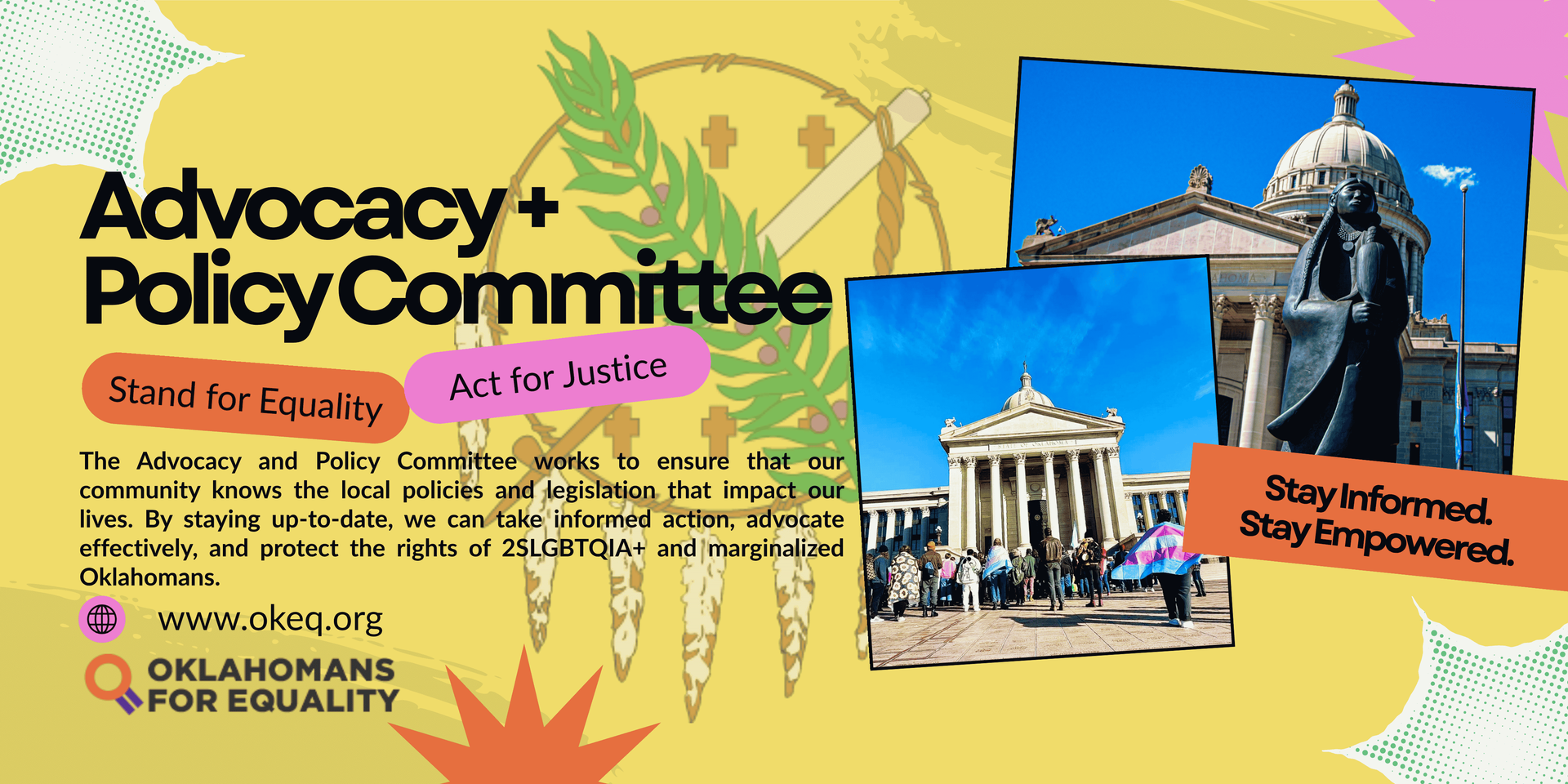
Stay Engaged. Stay Informed. Stay Involved.
Looking for meaningful ways to make a difference year-round? Join the OKEQ Advocacy & Policy Committee and be part of the work shaping a more equitable future for Oklahoma’s 2SLGBTQIA+ community.
This is your space to stay informed on local and state policy, support advocacy efforts, and help drive real change through community action.
💬 Learn what’s happening & Take action when it matters
🤝 Stand in solidarity with your community & Help build a stronger, more just Oklahoma
Whether you’re new to advocacy or already engaged, your voice and perspective matter. Together, we can create impact, one conversation, one vote, and one act of advocacy at a time.
To get involved, reach out to Jessica Meloy, Committee Vice Chair at jrmeloy@gmail.com.
Post Election FAQs
The Oklahomans for Equality Allied Attorney Group has prepared a Post-Election Frequently Asked Questions (FAQs) guide to address common concerns within the 2SLGBTQIA+ community following recent elections. This resource aims to provide clarity on potential impacts and offer guidance on navigating the current political landscape.
This is legal education and not legal advice. An attorney-client relationship is not created by this document. You should consult your lawyer before taking any action that has legal consequences.
2026 Oklahoma Legislative Session
What 2SLGBTQIA+ Oklahomans Need to Know About the 2026 Legislative Session
The Oklahoma Legislature is currently in session, and several bills moving forward could dramatically affect the lives, safety, and dignity of 2SLGBTQIA+ individuals, families, and communities across the state.
At Oklahomans for Equality, we are closely tracking these developments and sharing updates so our community understands what’s happening, how to take action, and where to find resources and support.
How the Legislative Session Works
Oklahoma’s legislative session runs from February through May each year. Throughout the session, lawmakers must meet several deadlines for bills to continue moving through the process. Missing one of these deadlines usually means a bill will not move forward this year.
Important Legislative Deadlines
• March 5 – Bills must pass out of committee in their chamber of origin
• March 26 – Bills must pass the full chamber where they were introduced
• April 23 – Bills must pass committee in the opposite chamber
• May 7 – Bills must pass the floor in the opposite chamber
These deadlines help determine which proposals are still active.
Why Some Bills Carry Over
Oklahoma lawmakers operate on a two-year legislative cycle. That means bills introduced in 2025 can still move forward in 2026 if they didn’t pass last year. They simply pick up where they left off in the process.
How State Agencies Implement Laws
When the Legislature passes laws, state agencies often create administrative rules explaining how those laws will work in practice. Sometimes lawmakers use a joint resolution, rather than a traditional bill, to change or repeal administrative rules.
Recent Change to Driver’s License Rules
A resolution passed by lawmakers repealed part of an administrative rule previously used by Service Oklahoma. That rule allowed transgender Oklahomans to change the gender marker on their driver’s license with:
• a court order
• a physician’s letter
The repeal was quietly signed into law on March 3, 2026 by Governor Stitt.
What This Means
The change removes the administrative rule that previously allowed gender marker updates on Oklahoma driver’s licenses.
• Existing licenses with updated markers remain valid
• However, the process to request a change is no longer available moving forward
Advocates and legal experts are continuing to evaluate the full impact of this change.
Legislation Still Moving This Year
Several bills introduced in 2025 are still active and could affect 2SLGBTQIA+ visibility and diversity initiatives.
These proposals include restrictions related to:
• HB 1219 – Restricts 2SLGBTQIA+ Pride recognition by state agencies
• SB 550 – Limits drag story hour events on public property
• SB 1006 – Restricts diversity, equity, and inclusion (DEI) initiatives in state government
New Bills Introduced in 2026
New proposals this year focus on issues such as:
• Gender identity policies – HB 1225, HB 3130, HB 3586
These bills could limit recognition of gender transitions, including prohibiting updates to legal documents and restricting access to state-supported transition care for minors.
• Birth certificate amendments – HB 1225, HB 3130, HB 3586
Proposals would prevent changing the biological sex listed on birth certificates.
• School library oversight – HB 2978, SB 1250
Increases restrictions and reporting requirements for materials considered “obscene” or “sexualized”, affecting 2SLGBTQIA+ inclusive books and resources.
• Restrictions on diversity and inclusion initiatives – HB 3132, HB 3134
Limits programs promoting DEI in schools and higher education, affecting campus climate and inclusive curricula.
• Policies affecting student spaces and parental access to records – HB 3242, SB 1328
Requires separation of sleeping and private spaces by biological sex in schools and expands parental access to minors’ medical information, impacting student privacy and safety.
2SLGBTQIA+ Oklahomans belong here.
Our community is part of the fabric of this state and has always been part of Oklahoma’s story. We deserve privacy, safety, dignity, and the freedom to live and thrive.
As policies continue to develop, Oklahomans for Equality will continue tracking these issues, sharing updates, and standing as a resource for our community. We want to ensure that no member of our community has to navigate these uncertain times alone or without support.
Visit our website or reach out to learn more about our support groups, mental health services, on-site medical clinic, and other community resources.
Oklahoma Legislative Information
Who Represents Me and How Do I Contact Them?
When do I Vote?